
You've built your own PBN sites. They're online, they have content, they're ready to link out. But something about them just looks... off. Like PBN sites. Like the kind of sites Google has been trained to identify and devalue.
You've built your own PBN sites. They're online, they have content, they're ready to link out. But something about them just looks... off. Like PBN sites. Like the kind of sites Google has been trained to identify and devalue.


You've built your own PBN sites. They're online, they have content, they're ready to link out. But something about them just looks... off. Like PBN sites. Like the kind of sites Google has been trained to identify and devalue.
This isn't random bad luck. There are specific patterns that make DIY PBN builds look fake—patterns that professionals learn to avoid but first-timers almost always fall into.
Let's break down what actually separates amateur builds from professional ones.
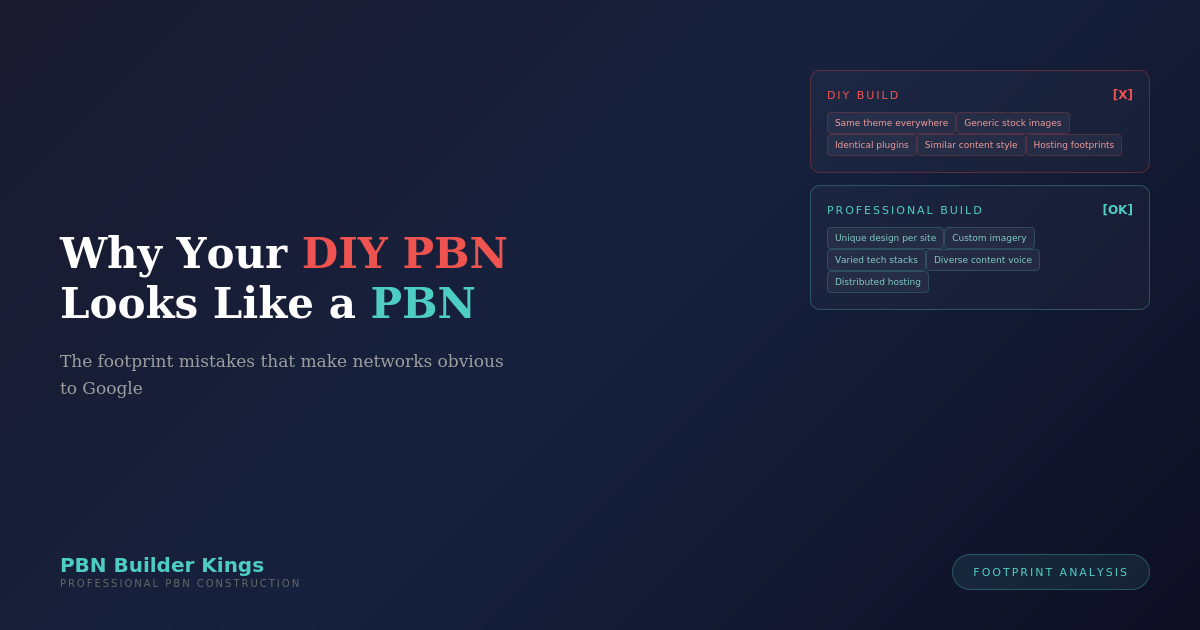
DIY builders typically pick a free theme, install it, and move on. Maybe they change the colours. Maybe they upload a logo. The structure, layout, and overall feel remain identical to thousands of other sites using the same theme.
The problem compounds when you use the same theme across multiple sites in your network. Now you have a group of sites that don't just look like generic WordPress sites—they look like each other.
Professional builds treat each site as unique. Different themes, or the same theme customised significantly enough to be unrecognisable. Different layouts. Different visual hierarchies. Each site should feel like it was built by a different person for a different purpose.
This takes more time. It takes design knowledge. It's exactly why DIY builders skip it and exactly why their sites look like template farms.
DIY PBN content often follows visible patterns:
Every post is roughly the same length—usually whatever word count the builder decided was 'enough.' Real blogs have variety. Some posts are 300 words. Some are 2000. The consistent length across all posts screams manufactured.
Every post has the same structure—intro paragraph, three subheadings with two paragraphs each, conclusion. Real content is messy. Some posts are listicles. Some are opinion pieces. Some are news updates. Uniform structure suggests uniform production.
Every post sounds the same—because it was all written by the same AI prompt or the same batch of spun articles. Real blogs have evolving voice, different moods, varying quality. Perfect consistency is artificial.
Professional builds vary content deliberately. Different lengths, different formats, different depths. The goal is organic irregularity—the natural messiness of a real site built over time.
WordPress sites reveal their plugins in various ways—JavaScript files, CSS classes, meta tags, HTML comments. DIY builders typically install the same plugin stack across all their sites because they have one workflow they follow.
Yoast SEO on every site. Contact Form 7 on every site. The same caching plugin, the same security plugin, the same everything. Each plugin leaves fingerprints in the source code. Identical fingerprints across sites are connections.
Professional builds vary plugin selection. Different SEO plugins across different sites. Different approaches to caching. Sometimes no contact form at all—does every PBN site really need one? The goal is eliminating patterns that could tie sites together.
DIY builds often skip the details that make sites feel legitimate because those details take time and don't seem to matter. But they do matter—they're exactly what separates real sites from obvious fakes.
The About page. DIY builds either skip it entirely or have a generic paragraph that says nothing. Real sites have About pages that tell a story, have personality, maybe include photos. It's a credibility signal that's obviously missing when it's not there.
Author information. Posts without author attribution, or with the same generic author across an obvious network. Real blogs have author bios, maybe author archives, information that suggests actual humans are involved.
Appropriate imagery. DIY builds use stock photos—often the same stock photos that appear on thousands of other sites. Or no images at all. Or images that don't match the content. Professional builds use varied imagery that actually fits the content and persona.
Navigation that makes sense. DIY sites often have navigation menus that reveal their artificial nature—categories that exist only for SEO, pages that serve no real purpose, structures that no real site would have.


Beyond the visible, there are technical patterns that algorithmic analysis can detect.
Identical deployment timing. Five sites all created on the same day, all with posts dated across the same range. Real sites don't spring into existence in batches.
Consistent technical configurations. Same permalink structure, same timezone settings, same WordPress configurations. Each choice might be minor, but identical configurations across sites create patterns.
Similar registration and setup patterns. Domains registered together, DNS changed together, sites going live together. Temporal patterns are footprints.
Hosting-level connections. All sites on the same shared hosting, same IP range, same nameservers. This is why proper PBN hosting matters—and why we recommend partners like pbn.ltd who understand footprint protection at the infrastructure level.
Perhaps the most obvious tell: how and where links to money sites appear.
DIY builds often have links that feel forced—stuck into content where they don't belong, with anchor text that's obviously optimised, in posts that exist solely to hold the link.
Professional builds create contexts where links make sense. The content genuinely relates to what's being linked. The anchor text is natural. The link placement feels like a real recommendation, not an SEO tactic.
This requires thinking about the link before writing the content—planning posts that naturally lead to link opportunities rather than jamming links into whatever content exists.
The difference between DIY and professional isn't just experience—it's process.
Professional builds start with planning. What's the persona? What kind of site is this supposed to be? What would a real site in this space look like? The answers inform every subsequent decision.
Design comes next—not just installing a theme, but building a visual identity appropriate to the persona. Colours, typography, layout choices that match what the site claims to be.
Content is created for the persona, not just for the niche. A local electrician's blog sounds different from an industry news site sounds different from a hobbyist forum. Voice matters.
Technical setup is varied deliberately. Different plugins, different configurations, deployed at different times. Avoiding patterns is an active consideration, not an afterthought.
And quality assurance catches the tells before delivery. Every site is reviewed for the patterns discussed above. Nothing goes out that looks like a PBN site.
DIY saves money upfront but costs more over time. Sites that look like PBN sites get deindexed. Networks with obvious patterns get burned. Domains that took money to acquire become worthless.
Professional builds cost more initially but create sustainable assets. Sites that look legitimate survive algorithmic updates. Networks without patterns continue working for years.
The question isn't whether you can build PBN sites yourself—of course you can. The question is whether you can build them well enough to not waste your investment. Most people can't, because they don't know what they don't know about detection patterns.
At PBN Builder Kings, this is what we do every day. View examples of our work at https://pbnbuilderkings.com/pbn-website-examples/ and see the difference professional building makes. When you're ready to build properly, our packages are at https://pbnbuilderkings.com/pbn-website-builders/.

Neil James is a PBN Expert. With world leading knowledge and spectacular results. When it comes to PBNs, there is no one better to have on your team!


© Copyright of PBN Builder Kings - All rights reserved


